Immune Function & Modulation Assays
Cell Migration & Chemotaxis Assays
Does your compound modulate immune-cell recruitment or tumor-cell migration under defined chemotactic and microenvironmental conditions?
Our kinetic transwell migration assays combine defined chemotactic conditions with live-cell imaging to quantify immune-cell chemotaxis and tumor-cell migration over time. Primary immune cells and selected cancer-cell models can be used to evaluate compound-associated enhancement or inhibition of migration, with complementary phenotypic and molecular profiling available to characterize the biological response.
Cell migration assay: format & readouts
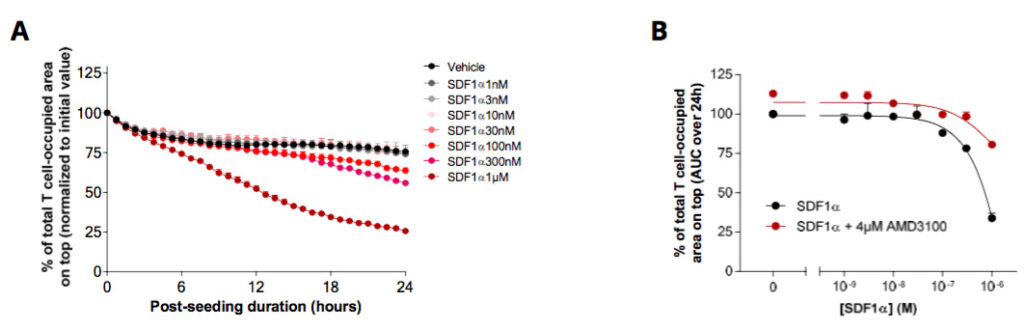
Real-time chemotactic migration of immortalized T cells toward SDF1α in a 96-well plate. Transmembrane migration quantified on the IncuCyte® live-cell analysis system.

Assay principle
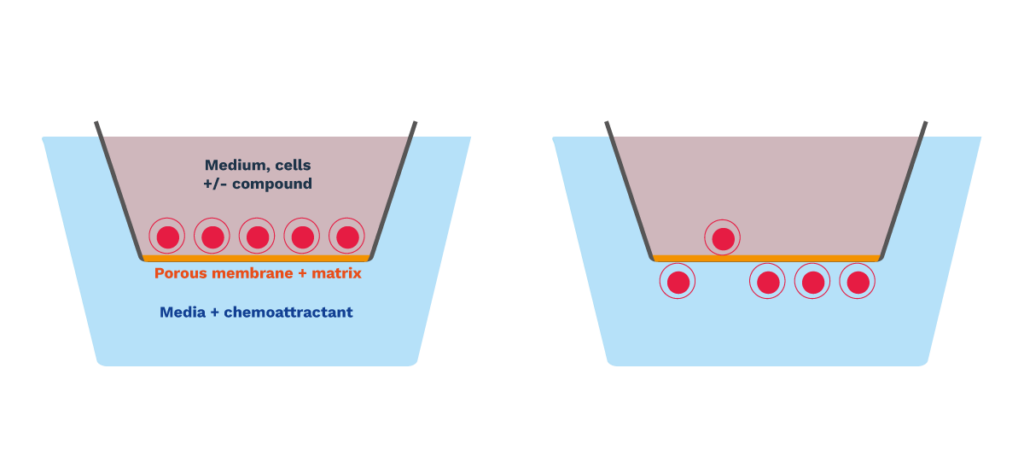
How our cell migration and chemotaxis assays work
1
Prepare and seed the cells
2
Establish the migration condition
3
Track migration kinetically
4
Add complementary biological readouts
Illustrative CELL MIGRATION data
T-cell, neutrophil and tumor-cell migration: representative results
Dose-dependent T-cell chemotaxis is inhibited by CXCR4 blockade
Primary human T-cell migration is induced in a concentration-dependent manner by CXCL12 (SDF-1α). CXCL12-driven migration is inhibited by the CXCR4 antagonist AMD3100, illustrating the assay’s ability to detect pathway-dependent modulation of T-cell chemotaxis.
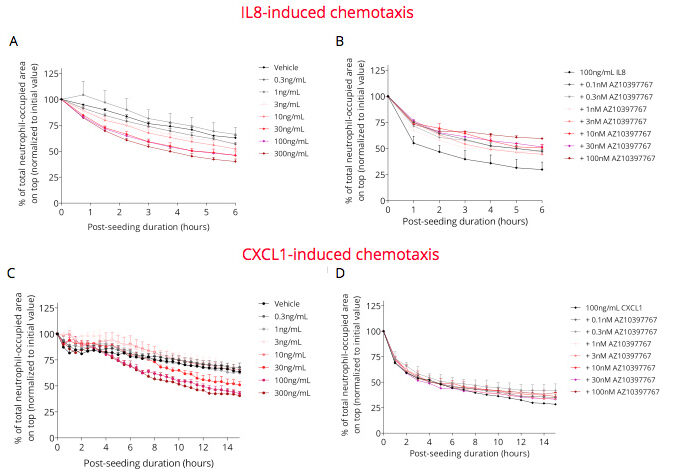
Neutrophil chemotaxis toward CXCL8 and CXCL1 is modulated by CXCR2 antagonism
Freshly isolated human neutrophils show concentration-dependent migration toward CXCL8 (IL-8) and CXCL1. Treatment with a CXCR2 antagonist partially inhibits migration induced by both chemokines, illustrating pharmacological modulation of neutrophil chemotaxis.
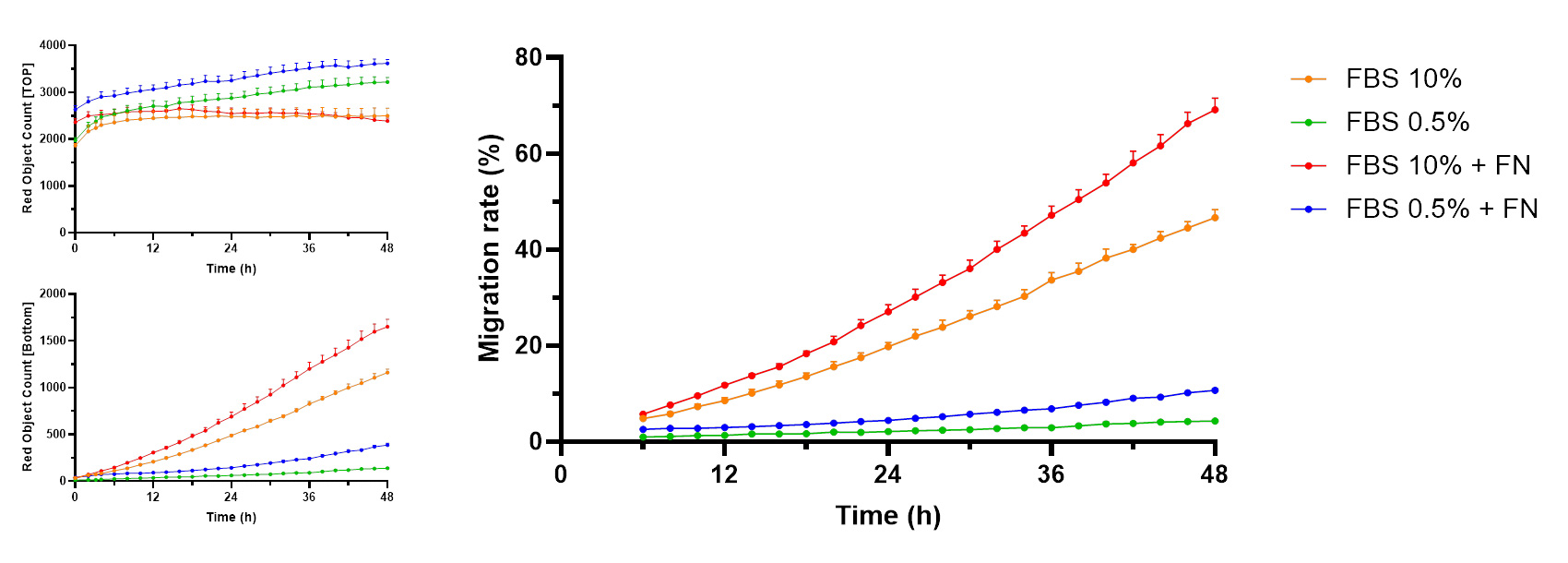
Serum-induced sarcoma cell migration is enhanced by fibronectin
Sarcoma cell migration was monitored by live-cell imaging over 48 hours in a transwell system. NucLight fluorescence was quantified in the upper and lower chambers and used to calculate migration rate.Higher serum conditions promoted sarcoma cell migration, while fibronectin further increased the migratory response.
These data illustrate the assay’s ability to quantify kinetic tumor-cell migration and evaluate how extracellular-matrix components modulate the response to migration-promoting conditions.
Making a difference as a preclinical CRO in oncology
Why work with Explicyte
The right model for the biological question
Ten years of functional oncology and immuno-oncology assays
Published, peer-reviewed science
One study director, end to end

Paul Marteau, PharmD (study director), Imane Nafia, PhD (CSO), Loïc Cerf, MSc (COO), Alban Bessède, PhD (founder, CEO), Jean-Philippe Guégan, PhD (CTO)
Contact our team
Discuss your migration study
Tell us about your compound and the migration question you need answered — recruiting effector cells, or blocking cancer-cell or suppressive-cell migration. We'll come back with a fit-for-purpose proposal and a PhD-level study director.
Frequently asked questions