Immune Function & Modulation Assays
Mixed Lymphocyte Reaction (MLR) Assay
Does your compound modulate dendritic-cell function, alter T-cell activation, or influence the interaction between the two?
Our allogeneic MLR assay combines primary human monocyte-derived dendritic cells (moDCs) and CD4+ T cells from unrelated donors to assess compound effects on dendritic-cell function and the resulting T-cell response. IFN-γ provides a primary functional readout, complemented where needed by cytokine profiling and immunophenotyping, while independent donor pairs enable assessment of response variability and consistency across donor backgrounds.
MLR assay format and readouts
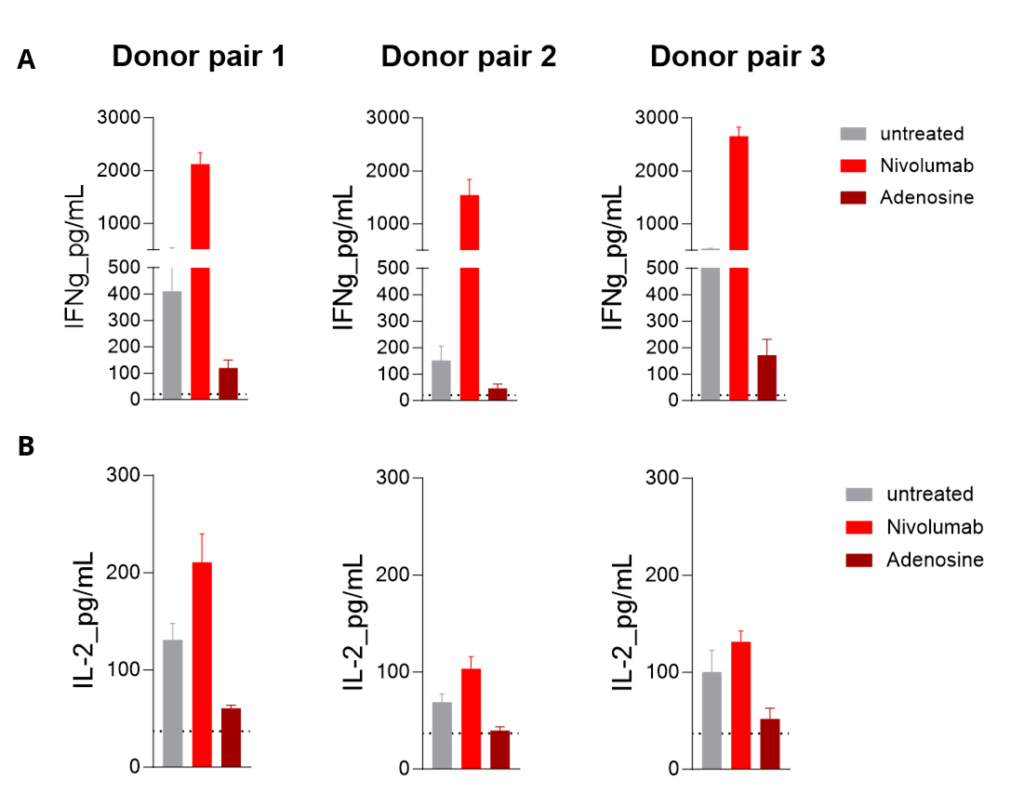
MLR responses in allogeneic human moDC/CD4+ T-cell co-cultures vary across independent donor pairs and are modulated by PD-1 blockade and adenosine. Peripheral blood monocyte-derived mature dendritic cells are co-cultured with allogeneic CD4+ T cells, and IFN-γ and IL-2 released into the supernatants are quantified. The allogeneic co-culture response increases after PD-1 blockade with nivolumab and is reduced under adenosine treatment.

Assay principle
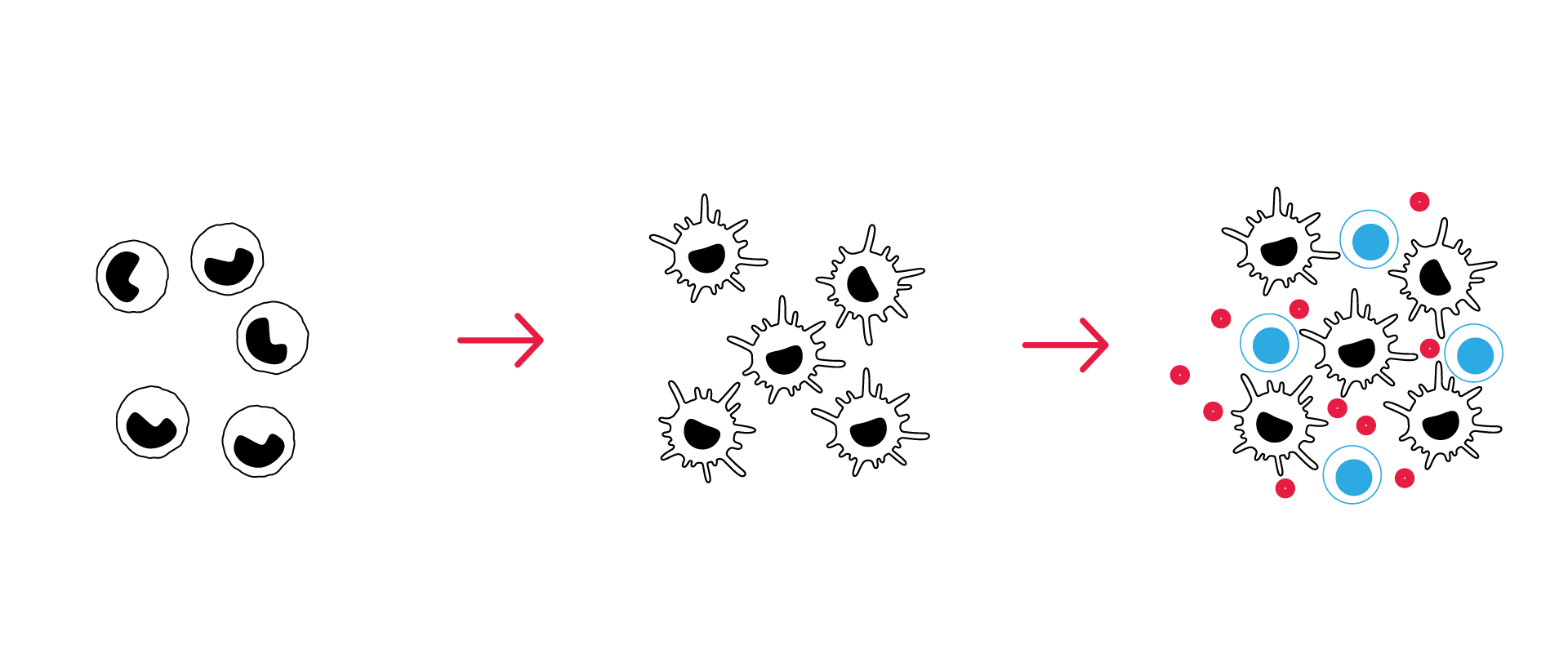
How the MLR assay works
1
Establish the allogeneic co-culture
2
Introduce the test compound
3
Quantify the immune response
4
Characterize the biological context
Illustrative MLR data
MLR assay for cancer immunotherapies: example results
PD-1 blockade enhances the allogeneic MLR response
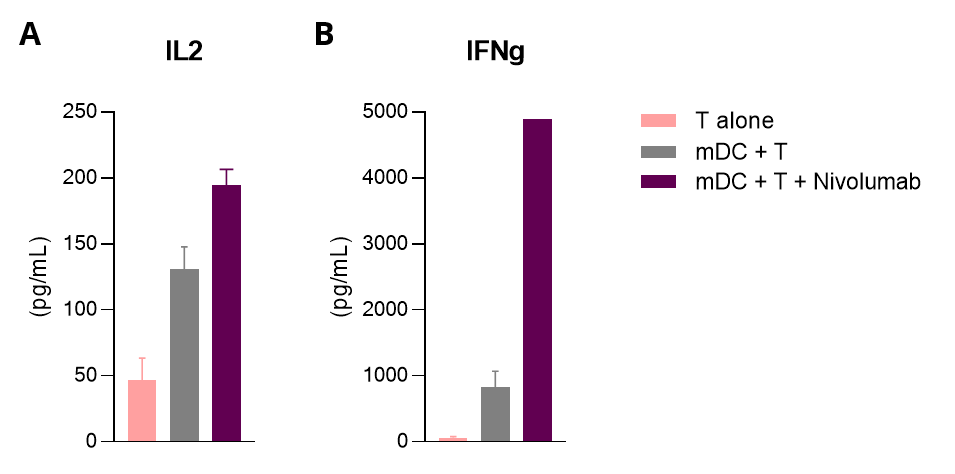
Mature monocyte-derived dendritic cells are co-cultured with allogeneic CD4+ T cells, and IL-2 (A) and IFN-γ (B) are quantified in the supernatants. Nivolumab increases the MLR response, as reflected by higher IL-2 and IFN-γ levels. These data illustrate the assay's ability to detect changes in allogeneic T-cell responses following checkpoint inhibition.
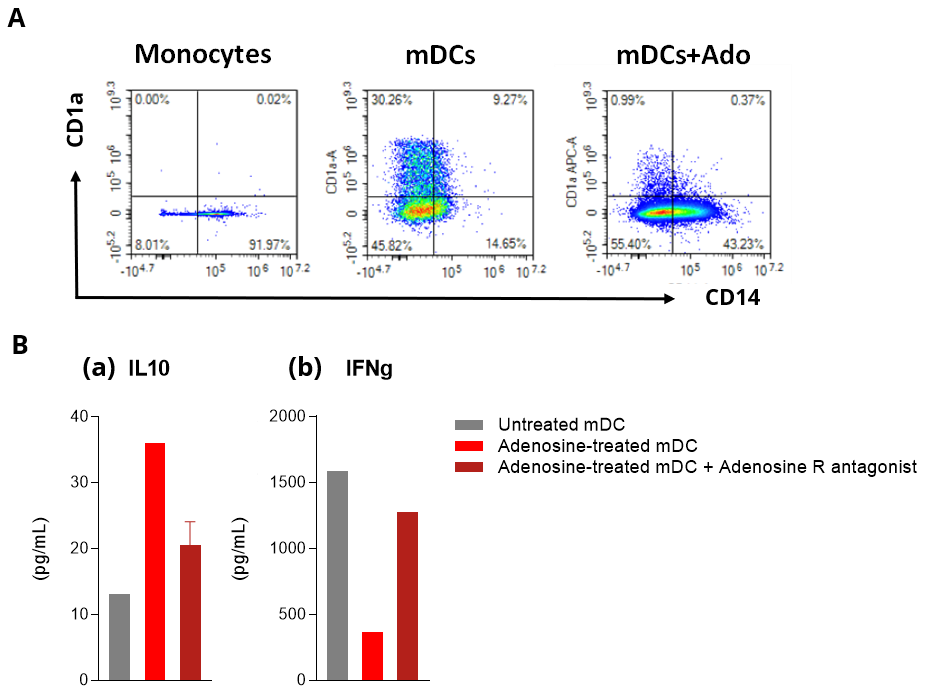
Adenosine modulates dendritic-cell phenotype and suppresses the MLR response
Monocyte-derived DCs were exposed to adenosine, with or without an adenosine-receptor antagonist. Flow cytometry was used to profile DC differentiation and maturation (A), while IL-10 and IFN-γ were quantified in DC and co-culture supernatants (B).
Adenosine is associated with a CD1a-low/CD14+ DC phenotype, increased IL-10 and reduced IFN-γ in the MLR. Adenosine-receptor antagonism reverses these changes, supporting a role for adenosine signaling in the modulation of the allogeneic DC/T-cell response.
Making a difference as a preclinical CRO in oncology
Why work with Explicyte
Deep immuno-oncology experience
A dedicated PhD study director
Independent donor pairs
From functional response to biological insight

Paul Marteau, PharmD (study director), Imane Nafia, PhD (CSO), Loïc Cerf, MSc (COO), Alban Bessède, PhD (founder, CEO), Jean-Philippe Guégan, PhD (CTO)
Contact our team
Discuss your MLR assay
Whether you're testing an immune checkpoint inhibitor, an agonist antibody, or a small molecule acting on an immunosuppressive pathway, we'll build an MLR study around your mechanism and endpoints — from single-agent screening to combination activity profiling.
Frequently asked questions